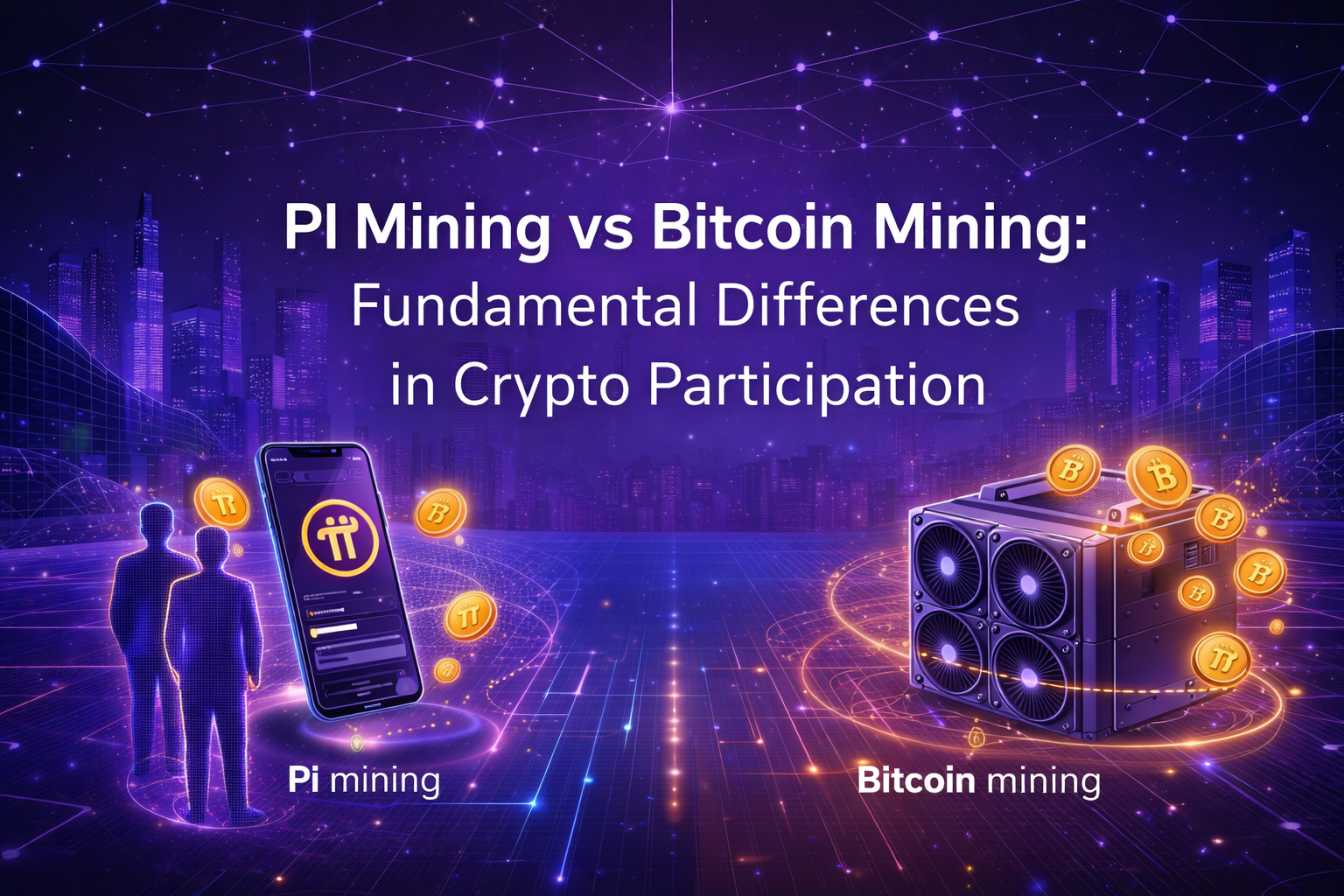
PI Mining vs Bitcoin Mining: Fundamental Differences in Crypto Network Participation
On the surface, they appear similar under the shared label of “mining.” However, beneath that label lie fundamental differences in their underlying mechanisms, participation thresholds, resource dependencies, and risk structures. Understanding these differences helps clarify how various crypto networks differ in design priorities and development stages, rather than reducing the comparison to simple measures of “efficiency” or “profitability”.
What Is PI Mining?
PI mining is a token distribution and network participation mechanism based on user identity verification and behavioral engagement on the network.
The mining model of Pi Network does not rely on computational competition. Instead, it lowers participation barriers to attract a large number of everyday users during the early stages of the network, aiming to rapidly build user scale and foundational network structure. In this sense, it resembles a “participatory distribution model” more than traditional hash-based mining.
Within Pi Network’s design, mining rates are not fixed. They are adjusted over time as the network grows and transitions through different phases, helping regulate the pace of token issuance.
Operationally, PI mining is conducted primarily through a mobile application. Users maintain their mining eligibility by periodically confirming their active status. This process does not consume device computing power and does not generate significant energy costs.
Structurally, the network includes different participant roles with distinct functions, including regular users, technically inclined participants who run nodes, and trust circles formed through social connections. This framework is intended to improve the identification of real users and reduce the impact of automated or mass-created accounts on the network.
What Is BTC Mining?
BTC mining is a computational competition process based on Proof of Work, PoW, designed to secure the Bitcoin network and issue new bitcoins.
In the Bitcoin network, miners compete for the right to add new blocks by continuously performing hash calculations. Each new block requires miners to commit real computational resources and incur electricity costs. The miner who successfully packages a block receives block rewards and transaction fees. This mechanism simultaneously supports token issuance and network security.
As the network has matured, Bitcoin mining has evolved from early personal computer participation to an industrialized model dominated by specialized mining hardware and large-scale mining facilities. Hash rate concentration, energy consumption, and mining costs have become structural features that cannot be ignored.
What Are the Core Differences Between PI Mining and BTC Mining?
The differences between PI mining and BTC mining cannot be reduced to a single metric. They extend across mechanism design, participation models, and sources of risk.
Differences in Core Mechanisms and Resource Dependence
PI mining treats identity, time, and user behavior as its primary input factors, without requiring participants to contribute computational power or energy;
BTC mining relies entirely on computational power and electricity input, with security built on high resource costs.
This divergence shapes their distinct approaches to network security models, participation thresholds, and scalability.
Differences in Participation Models and Network Roles
PI mining emphasizes “broad participation”, allowing ordinary users to join via mobile devices.
BTC mining increasingly emphasizes “professional participation”, leaving limited room for direct participation by ordinary users.
Differences in Risk and Constraint Structures
- Risks in PI mining are more closely tied to the evolution of network rules, ecosystem maturity, and the pathway toward decentralization.
- Risks in BTC mining are primarily associated with hash rate concentration, cost volatility, energy policies, and long term profitability uncertainty.
Key Dimension Comparison: PI Mining vs BTC Mining
| Comparison Dimension | PI Mining | BTC Mining |
| Core Mechanism | Identity and participation driven distribution model | Proof of Work, PoW |
| Primary Resource Input | Time, identity, and behavioral participation | Hash power, electricity, and hardware |
| Participation Threshold | Low, designed for everyday users | High, oriented toward professional miners |
| Energy Consumption | Extremely low | High |
| Mining Format | Mobile based participation | Specialized mining machines and mining farms |
| Source of Network Security | User authenticity and structural design | High computational cost |
| Path to Decentralization | Relies on user scale and structural evolution | Relies on hash power distribution |
| Development Stage Positioning | Geared toward early stage network expansion | Already in a mature operational stage |
Why “Mining” Does Not Mean the Same Thing Across Crypto Networks
The term “mining” originally described the process in Bitcoin of competing through computational power to earn block rewards. As crypto networks have diversified, however, the term has broadened to describe any mechanism through which participants contribute some form of resource to a network and receive token incentives in return.
Across different projects, the recognized “resource” may be computing power, storage, bandwidth, time, identity, or user behavior itself. Therefore, whether a mechanism consumes computational power is not the sole criterion for evaluating its validity. Its appropriateness depends more on whether it aligns with the network’s objectives.
Why Bitcoin’s Standards Cannot Be Directly Applied to PI Mining
Bitcoin’s mining standards are built around a design goal that prioritizes “high security”. By contrast, Pi Network’s mechanism is more focused on “lowering participation barriers” and “expanding its user base”. The core problems each network aims to solve are different, and they are also at different stages of development.
Applying Bitcoin’s benchmarks for hash power, security, or energy consumption directly to PI mining risks overlooking the specific objectives that its mechanism is designed to serve. This can blur the distinction between “differences in design orientation” and “judgments about superiority or inferiority”.
Conclusion
PI mining and BTC mining represent two fundamentally different pathways for participating in crypto networks. One prioritizes low barriers and user base expansion, while the other emphasizes computational competition and security certainty. Recognizing this structural divergence allows for a more balanced understanding of what “mining” truly means in different crypto contexts and helps avoid evaluating diverse blockchain designs through a single standard.
Share
Content


Related Articles

In-depth Explanation of Yala: Building a Modular DeFi Yield Aggregator with $YU Stablecoin as a Medium
BTC and Projects in The BRC-20 Ecosystem

What Is a Cold Wallet?

Blockchain Profitability & Issuance - Does It Matter?

What is the Altcoin Season Index?