What is Bitcoin Cash?

What Is Bitcoin Cash (BCH)?
Bitcoin Cash (BCH) is a cryptocurrency that originated from a hard fork of the original Bitcoin blockchain in 2017. Its primary focus is on “on-chain scaling,” which means directly increasing block size to improve the system’s transaction throughput. A hard fork occurs when community members disagree on protocol upgrades, resulting in two separate blockchains. BCH emphasizes low transaction fees and faster confirmations, while maintaining a fixed maximum supply of 21 million coins.
Current Price, Market Cap, and Circulating Supply of Bitcoin Cash (BCH)
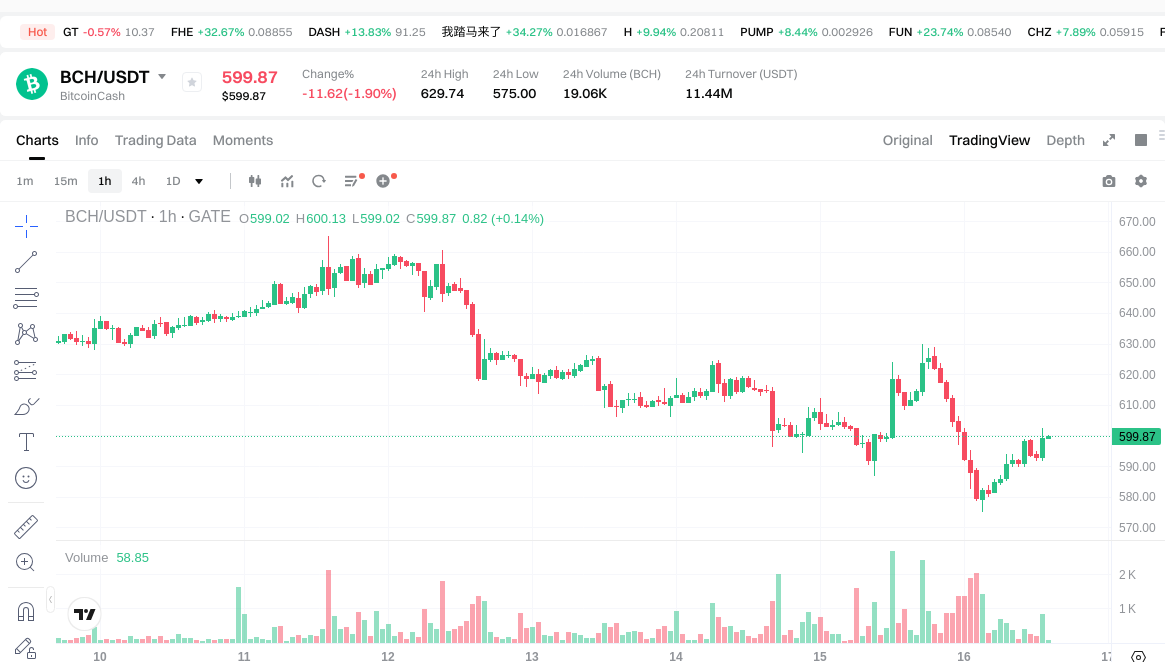
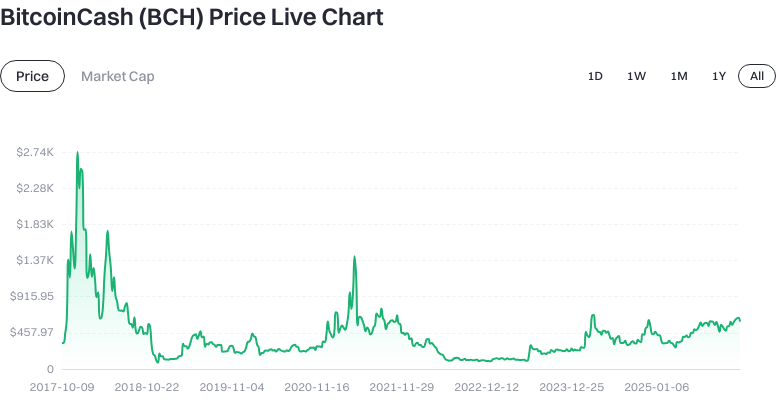
As of 2026-01-16, BCH is priced at approximately $599.80. The circulating supply is 19,981,428.021651 BCH, with a maximum supply capped at 21,000,000 coins. Its market capitalization is roughly $11,984,860,527.39, with a fully diluted valuation of the same amount and a market dominance of about 0.35%.
View the BCH/USDT price
Recent price movements: +1.21% over 1 hour, -2.27% over 24 hours, -5.68% over 7 days, +9.89% over 30 days. The 24-hour trading volume is approximately $11,662,278.06.
Check the latest BCH price and market data
Circulating supply refers to the amount of BCH available for trading in the market, while fully diluted market cap represents the estimated total value based on the maximum possible supply.
Who Created Bitcoin Cash (BCH) and When?
Bitcoin Cash was launched in 2017, driven by mining pools and community support. ViaBTC released BCH based on the Bitcoin ABC proposal through a hard fork from the original Bitcoin chain. The goal was to uphold Satoshi Nakamoto’s vision of “peer-to-peer electronic cash.” The split was caused by differing views on scaling: BCH opted to increase block size on the main chain to accommodate more transactions, rather than relying primarily on off-chain solutions.
How Does Bitcoin Cash (BCH) Work?
BCH operates on a Proof of Work (PoW) consensus mechanism, where miners compete to add new blocks by solving hash functions using the SHA-256 algorithm. Each block is targeted to be created roughly every 10 minutes. BCH features significantly larger maximum block sizes compared to Bitcoin, enabling higher throughput and reducing congestion. It utilizes an updated difficulty adjustment algorithm that more smoothly responds to changes in network hash power. Transactions use the UTXO (Unspent Transaction Output) model for efficient parallel verification and processing. To prevent replay attacks with the Bitcoin network, BCH implements replay protection, upgraded transaction signatures, and uses the CashAddr address format to minimize user errors.
What Can Bitcoin Cash (BCH) Be Used For?
BCH is primarily designed for everyday payments and transfers. Thanks to low transaction fees and higher on-chain throughput, it is well-suited for retail payments and cross-border remittances. Merchants can receive quick payment confirmations, minimizing wait times; international transfers are completed in minutes with lower fees compared to traditional methods. BCH also supports online tipping, content monetization, and micropayments, enhancing user experience in digital environments.
What Are the Main Risks and Regulatory Concerns for Bitcoin Cash (BCH)?
- Price Volatility: Crypto assets can experience significant short-term price swings.
- Hash Power and Security: PoW network security depends on overall hash rate; centralized mining power can increase the risk of a 51% attack, where an entity controlling the majority of hash power could disrupt transactions.
- Operational Risks: When depositing or withdrawing, always ensure you select the correct BCH network and address format to avoid accidental transfers to the Bitcoin chain.
- Regulatory Risks: Compliance requirements for crypto assets vary by region and may affect fiat channels, taxation, and merchant acceptance.
- Custody and Private Key Risks: Storing assets on exchanges involves third-party custody—enable security features; if self-custodying, securely back up mnemonic phrases and private keys to prevent loss or exposure.
This information does not constitute investment advice.
What Is the Long-Term Value Proposition of Bitcoin Cash (BCH)?
The long-term value of BCH depends on real-world adoption for payments, growth of merchant ecosystems, and network security. On-chain scaling delivers lower fees and a more direct payment experience, supporting applications in retail and cross-border remittances. However, larger blocks increase full node operating costs and require a balance between throughput and decentralization. If merchant acceptance, wallet support, and developer activity continue to grow, BCH’s competitive positioning as “electronic cash” will strengthen. Nevertheless, it faces competition from Bitcoin’s off-chain scaling solutions (like Lightning Network for fast microtransactions) and stablecoin payment systems.
How Can I Buy and Safely Store Bitcoin Cash (BCH) on Gate?
Step 1: Register an account on gate.com, complete identity verification (KYC), and activate security features such as two-factor authentication (2FA) and anti-phishing codes.
Step 2: Buy USDT through the “Fiat” or “Buy Crypto” portals or deposit funds into your account balance. Pay attention to fees and settlement methods.
Step 3: Go to spot trading, search for “BCH/USDT,” then place a market or limit order. Market orders execute at current prices; limit orders allow you to set your own price and wait for execution.
Step 4: For self-custody, go to “Withdraw,” select the “BCH chain,” and test with a small amount first. Back up your mnemonic phrase offline in your personal wallet, set strong passwords, and securely manage your private key. Never send BCH to a Bitcoin (BTC) address.
Step 5: For short-term holding or active trading, you can keep BCH in your Gate account with withdrawal whitelists, device management, and login alerts enabled. For long-term storage, consider using hardware wallets or cold storage for enhanced private key security.
How Does Bitcoin Cash (BCH) Differ from Bitcoin?
- Scaling Strategy: BCH focuses on on-chain scaling (larger blocks for more transactions), while Bitcoin prioritizes off-chain scaling solutions like the Lightning Network.
- Fees & Payment Experience: BCH generally offers lower transaction fees and faster confirmations on-chain—ideal for everyday small payments; Bitcoin’s main chain is better suited for high-value settlements while microtransactions rely more on Lightning Network.
- Security & Ecosystem: Both use PoW consensus with a 21 million coin cap, but Bitcoin has higher hash rate, node count, brand recognition, and liquidity. BCH targets payment functionality with a merchant-focused ecosystem.
- Compatibility: While both use similar algorithms and UTXO models, their address formats and networks differ—careful distinction is required when depositing or withdrawing.
Summary of Bitcoin Cash (BCH)
Bitcoin Cash (BCH) emerged from a debate over scaling within the Bitcoin community. By increasing block size and reducing fees, it aims to enhance on-chain payment experiences while retaining Bitcoin’s scarcity through its supply cap and PoW consensus model. Current data shows BCH has significant market value and trading activity but remains subject to price volatility as well as hash power and regulatory challenges. For users seeking immediate on-chain payments, BCH offers clear advantages; operationally, always place orders according to Gate’s guidelines—select the correct network for withdrawals (test with small amounts first), enable two-factor authentication and whitelisting, and securely store mnemonic phrases and private keys if self-custodying. While monitoring ecosystem development, continue to assess fees, confirmation speed, and security—and choose payment or storage solutions that fit your needs.
FAQ
Are Bitcoin Cash and Bitcoin the Same Coin?
No. Bitcoin Cash (BCH) is an independent cryptocurrency created in 2017 via a fork from Bitcoin. While both share similar technical foundations, BCH uses a larger block size (8MB→32MB) to enable faster and cheaper transactions—Bitcoin maintains its original design. Think of Bitcoin as the “original version” and BCH as an “improved version” aimed at solving transaction congestion.
How Fast Are Transactions and How Low Are Fees with Bitcoin Cash?
Bitcoin Cash transactions are faster with lower fees compared to Bitcoin. With larger block capacity, BCH can process more transactions per second—average confirmation times are about 10 minutes with fees typically under $0.01. In contrast, during periods of high network congestion on Bitcoin, fees can reach several tens of dollars—this cost advantage is central to BCH’s design.
Is Bitcoin Cash Suitable for Everyday Payments?
BCH is generally more suitable than Bitcoin for everyday payments due to its low fees and quick confirmations—it acts more like "electronic cash," fulfilling its creator’s vision. However, merchant acceptance remains relatively limited; today it’s mainly used for cross-border transfers, small transactions, or spending at supported online shops. You can buy and manage BCH via the Gate platform.
Why Is Bitcoin Cash Much Cheaper Than Bitcoin?
The price gap mainly stems from market recognition and demand. As the original cryptocurrency with the highest profile, Bitcoin attracts greater institutional and user attention—resulting in higher demand and prices. Although BCH offers technical advantages, its market share and brand awareness are lower, directly impacting its valuation. Both coins have capped total supplies near 21 million; their prices reflect how the market values each project.
Will Bitcoin Cash Be Replaced or Disappear Because of Bitcoin?
Bitcoin Cash and Bitcoin have distinct ecosystems—they’re unlikely to replace each other in the short term. BCH focuses on payment use cases while Bitcoin serves as a store of value; their roles differ. However, risks for BCH include community splits, low adoption rates, or increased competition from other cryptocurrencies. Long-term prospects depend on ecosystem growth and application expansion—investors should evaluate these factors independently.
Key Terms Related to Bitcoin Cash (BCH)
- Proof of Work (PoW): A consensus mechanism where miners compete using computational power to validate transactions and produce new blocks.
- Block Size: BCH increased block size up to 32MB versus BTC’s 1MB—raising transaction throughput.
- Mining: The process where miners solve complex mathematical problems to validate transactions, create new blocks, and earn BCH rewards.
- UTXO Model: The Unspent Transaction Output model used by BCH to track ownership of funds.
- Transaction Confirmation: After being included in a block, transactions gain network confirmations; more confirmations make them harder to alter.
- Difficulty Adjustment: Automatic recalibration of mining difficulty based on network hash rate to maintain average block time around 10 minutes.
Further Reading & Resources on Bitcoin Cash (BCH)
-
Official Website / Whitepaper:
-
Development / Documentation:
-
Media / Research:
Related Articles

What Is USDT0

Web3 Payment Research Report: How Stablecoins Will Evolve in 2025