


Bithumb mistakenly sent 40 billion USD worth of Bitcoin! The accounts were frozen for 35 minutes, during which 99% of the funds were recovered.

Bithumb mistakenly sent 620,000 BTC (worth $40 billion) to 695 users on February 6 (intended to distribute 2,000 KRW). The team discovered the error within 20 minutes and froze the accounts within 35 minutes. This incident triggered a flash crash in Bitcoin, dropping its price to $55,000. Ultimately, the team recovered 99.7% of the funds. Online users received 20,000 KRW and zero trading fees for 7 days.
Data Disaster: 2,000 KRW Turns into 620,000 BTC
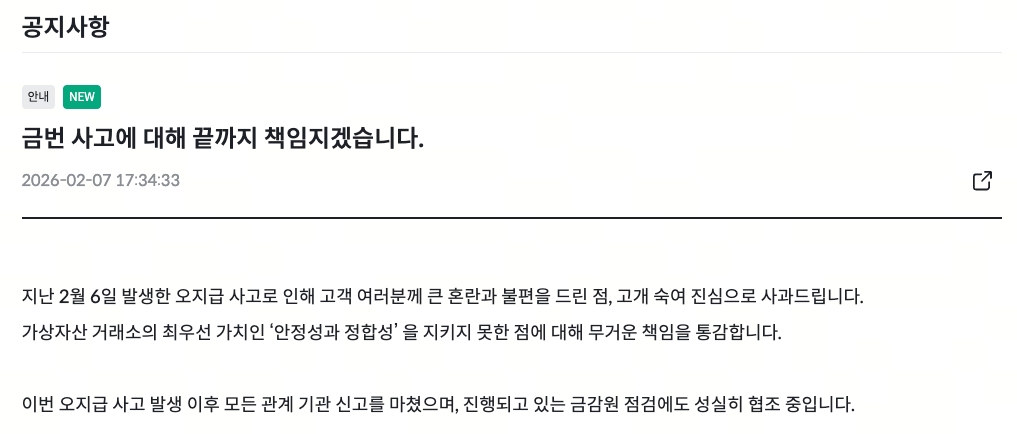
(Source: Bithumb)
The issue began with a small promotional reward campaign. About 695 users were supposed to receive approximately 2,000 KRW each. However, due to data entry errors, the actual payments far exceeded expectations. Some users received thousands of Bitcoins instead of small rewards. The exchange stated that roughly 620,000 BTC were mistakenly sent out. The error was detected within about 20 minutes. Subsequently, Bithumb began freezing withdrawals and trading for affected accounts. The freeze process was completed in approximately 35 minutes.
Calculating 620,000 BTC at the then-price of about $70,000 per BTC, the total value was approximately $434 billion, making it one of the largest mistaken transfers in cryptocurrency exchange history. If these Bitcoins had entered the market or been withdrawn, Bithumb could have faced bankruptcy. Fortunately, rapid response and account freezes prevented catastrophic consequences. The 20-minute detection and 35-minute freeze demonstrate highly efficient crisis management.
Some users’ sudden sell-offs caused a brief flash crash. Bitcoin’s price plummeted by 17% to about 55,000 USD (8,110 KRW), then recovered to normal levels. Although short-lived, this flash crash caused real losses for traders during that period. Some may have panicked and sold at low prices or triggered stop-loss orders, resulting in irreversible losses.
Timeline and Impact
Mistaken Transfer Volume: 620,000 BTC, worth about $400 billion
Beneficiary Users: 695 (originally meant to receive 2,000 KRW)
Discovery Speed: Error found within 20 minutes
Account Freeze Speed: Completed within 35 minutes
Market Impact: BTC flash crash of 17% to $55,000
The company emphasized that this incident was not caused by a hacking attack but was due to a simple input error during reward distribution. Customer funds were not threatened, and operations have now returned to normal. Clarifying this distinction is crucial for maintaining Bithumb’s reputation, as hacking and internal errors are viewed very differently in the market—hacking implies security vulnerabilities, while human error is seen as a mistake.
Miraculous Recovery of 99.7% of Funds
Bithumb stated that nearly all of the mistakenly sent Bitcoins have been recovered. Out of 620,000 BTC, approximately 618,212 have been returned, accounting for about 99.7%. Some users have sold part of their Bitcoins. The exchange also recovered about 93% of the sold Bitcoins. Currently, only about 125 BTC remain unrecovered.
A 99.7% recovery rate is extremely rare in such incidents. This success is attributed to Bithumb’s quick response and enforcement measures. Freezing accounts prevented users from withdrawing funds externally, fundamentally stopping capital flight. For those who sold their Bitcoins, Bithumb may have used reverse transactions or negotiated with buyers to recover assets. The 93% recovery of sold Bitcoins shows significant post-incident resource investment.
The remaining 125 BTC, roughly valued at $8.75 million (based on $70,000 per BTC), represents a manageable loss for a major exchange. Compared to the $40 billion scale of the mistaken transfer, the final loss is only 0.02%, approaching a miracle in crisis handling. Users who successfully withdrew or sold their Bitcoins may face legal action from Bithumb, as these transfers were clearly erroneous.
From a technical perspective, this incident exposed serious vulnerabilities in Bithumb’s system. The reward distribution system should have multiple checks, including caps on amounts, anomaly detection, and manual review. The fact that such an obviously abnormal figure as 620,000 BTC could pass through the system indicates significant internal control flaws. Bithumb’s promised system upgrades must fundamentally address this issue.
110% Compensation and Trust Rebuilding with a Hundred-Billion Fund
Bithumb announced it will fully compensate affected users. The total estimated user loss is about 10 billion KRW. During the panic, users who sold items at low prices will receive 110% compensation, covering the full difference plus an additional 10%. Additionally, all online users during the incident will receive 20,000 KRW and zero trading fees for 7 days.
The 110% compensation plan aims to turn the crisis into an opportunity for trust rebuilding. The extra 10% can be seen as an apology gesture and customer relationship cost. For users forced to sell Bitcoin at $55,000 during the flash crash, if the market price was $70,000, they would receive a $15,000 difference plus an extra 10%, totaling $16,500.
All online users will receive a universal 20,000 KRW (about $14) compensation, acknowledging that even unaffected users are impacted by market volatility and psychological stress. The 7-day zero-fee offer is a broader customer retention measure, encouraging continued trading on the platform.
Bithumb’s Three-Tier Compensation Scheme
Directly Affected Users: 110% compensation (difference + 10%)
Online Users: 20,000 KRW universal compensation
All Users: Seven days of zero trading fees
Furthermore, the exchange plans to establish a permanent customer protection fund of 1,000 billion KRW (about $700 million) to handle future similar incidents. Such institutionalized risk buffers are uncommon among crypto exchanges, reflecting Bithumb’s effort to build long-term resilience.
System Upgrades with AI Monitoring and External Audits
Bithumb stated it will upgrade its internal control systems. The company plans to improve asset checks and implement more rigorous multi-step approval processes. Additionally, a new AI system will be introduced to monitor transactions in real-time for anomalies. An external security firm will audit its systems, with results to be made public. The CEO said the company will take full responsibility and is committed to rebuilding customer trust after this mistake.
The AI monitoring system is central to the technical upgrade. Machine learning algorithms will analyze all transfers and reward distributions instantly. When abnormal patterns are detected—such as a single reward exceeding 10,000 BTC—alerts will trigger and execution will be paused. This automated oversight is faster and less error-prone than manual review.
Publicly sharing external security audit results increases transparency. Independent third-party audits and published findings allow users and regulators to verify that Bithumb has implemented corrective measures. Such transparency is vital for trust rebuilding, especially in South Korea’s tightly regulated market.
The company has informed regulators about this incident and is cooperating with investigations. The Financial Supervisory Service (FSS) may conduct an independent probe and could impose fines or require additional reforms. An active and cooperative stance can mitigate regulatory penalties.
For the crypto exchange industry, the Bithumb incident serves as a critical warning. Even large exchanges are vulnerable to simple human errors causing major crises. It underscores the importance of multi-factor verification, anomaly detection, and rapid response mechanisms. Other exchanges may learn from this and strengthen their internal controls.
Related Articles
Bitcoin Volatility Returns As Investors Reassess Crypto Portfolio Risk
K33: Bitcoin may have already bottomed at $60,000! Multiple historic panic-selling signals have appeared
Analyst Says $60K Bitcoin May Look “Obviously Cheap” If 200W EMA Holds