


ADA Price Crashes 80% From Peak: Is This a Historic Buying Opportunity?
Cardano (ADA) price has plunged over 80% from its December 2024 high, trading near multi-year lows. Amid this collapse, a major analyst spots a high-reward buying setup, while the launch of CME ADA futures triggers unexpected selling pressure. This deep dive explores the technical signals, on-chain whale activity, and the conflicting market forces shaping Cardano’s critical 2026 price juncture.
Cardano in Crisis: An 80% Plunge to Multi-Year Lows
The Cardano (ADA) market is experiencing one of its most severe contractions in recent history. As of February 2026, the price of ADA has collapsed by more than 80% from its peak near $1.32, recorded in December 2024. This dramatic descent has brought the layer-1 blockchain token down to the $0.26 - $0.33 range, a price level not seen since October 2023. From a broader perspective, ADA now trades approximately 90% below its all-time high of $3.10, set during the 2021 bull market frenzy.
This precipitous decline has unfolded within a challenging macro environment for cryptocurrencies, placing Cardano among the hardest-hit major assets. The drop has erased tens of billions in market capitalization, with ADA’s total valuation currently standing around $9.4 billion. Despite the bleak price action, a significant narrative is emerging among certain market analysts: that such extreme depreciation may be setting the stage for a generational buying opportunity. This perspective hinges on historical patterns where ADA underwent prolonged periods of consolidation and decline before erupting into massive rallies, a cycle that some believe is primed to repeat.
Oversold Signals and Key Support: The Technical Bull Case
A closer examination of Cardano’s weekly chart reveals several technical indicators flashing classic oversold signals. The Relative Strength Index (RSI), a momentum oscillator, has plunged to a reading of 28. Values below 30 typically suggest an asset is oversold and may be due for a corrective bounce or trend reversal as selling pressure exhausts itself. Concurrently, the Stochastic Oscillator has also dipped into oversold territory, reinforcing the notion that the bearish momentum may be overextended in the short term.
From a price structure perspective, ADA is testing a historically significant support zone. A critical level to watch is $0.2212, identified as the neckline of a previous head-and-shoulders pattern. This zone has acted as a formidable floor during past market cycles, repelling further declines and serving as a launchpad for recoveries. Notably, popular analyst Crypto Jebb has highlighted this setup, calculating a risk-to-reward ratio exceeding 8:1 for entries at current prices. His medium-term targets range from $1.50 to $2.00 over the next 12-24 months, which would represent gains of over 300% from recent levels. This thesis is largely chart-based, acknowledging that fresh, bullish on-chain or fundamental catalysts would be needed to fuel such a move.
CME Futures Launch: Bullish Catalyst or Bearish Trap?
In a significant institutional development, the CME Group launched regulated futures contracts for Cardano (ADA), Chainlink (LINK), and Stellar (XLM) on February 9, 2026. Traditionally, the introduction of such products is viewed as a milestone of maturity and legitimacy, potentially paving the way for increased institutional investment. However, the market’s immediate reaction defied conventional wisdom. Instead of rallying on the news, ADA’s price fell nearly 3%, slipping from around $0.272 to $0.2608.
This counterintuitive price action underscores a critical market dynamic: in weak underlying conditions, even positive news can be “sold into” by traders looking to exit positions. Data revealed a fascinating split in market behavior. While regulated futures went live, speculative activity on platforms like BitMEX exploded, with ADA futures volume surging an astonishing 48,770%.
This indicates a massive influx of leveraged speculation. Crucially, Open Interest (OI)—the total number of outstanding derivative contracts—actually declined from $490 million to $425 million during this period. This combination of rising volume but falling OI, alongside a dropping spot price, signals that the leverage was likely skewed toward short-term, bearish bets or that bulls were rapidly closing positions, not accumulating new ones.
Key Cardano (ADA) Metrics at a Glance
Price Performance: Down >80% from Dec 2024 high ($1.32); down ~92% from 2021 ATH ($3.10).
Technical Indicators: Weekly RSI at 28 (Oversold); Stochastic Oscillator oversold; Testing key support at ~$0.22.
Market Data: Current price ~$0.26-$0.33; Market Cap ~$9.4B; CME Futures launched Feb 9, 2026.
On-Chain Insight: Whale accumulation rising per CryptoQuant; Retail sentiment deeply negative.
Development Pipeline: Midnight zk-sidechain launch imminent; Leios upgrade & Pentad program in progress.
The Great ADA Divide: Whales vs. Retail Sentiment
Beneath the surface of the falling price, on-chain data paints a picture of stark divergence between different classes of investors. While retail confidence has deteriorated markedly—evidenced by panic selling and negative sentiment across social platforms—a different story is unfolding for larger holders. Data from analytics firm CryptoQuant indicates that whale entities (large holders) have been actively accumulating hundreds of millions of ADA tokens from late 2025 into early 2026.
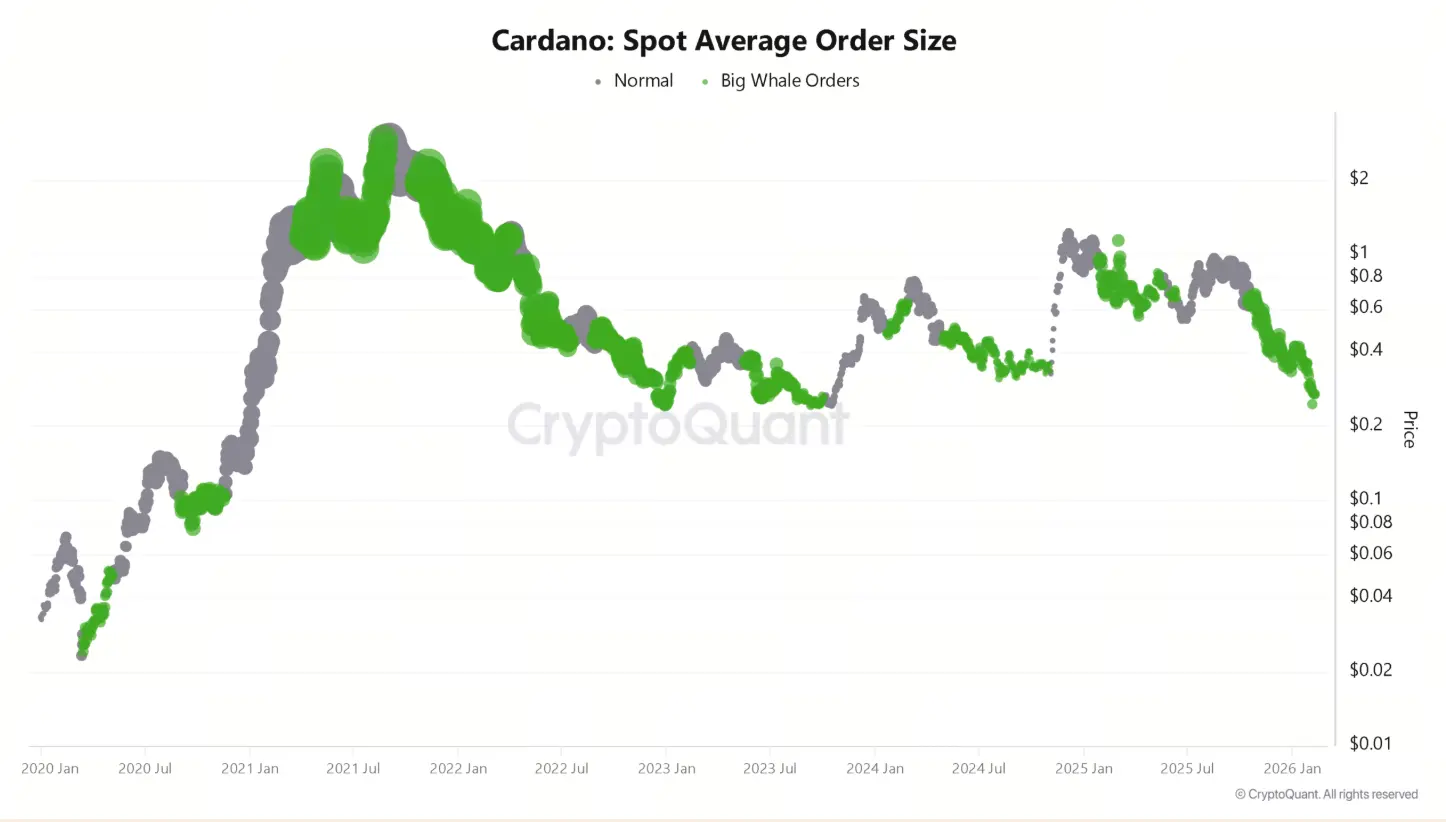
(Source: CryptoQuant)
This accumulation accelerated as the price continued to bleed lower, a strategy often described as “catching a falling knife” or, more strategically, as dollar-cost averaging into a long-term position. This behavior suggests calculated patience from sophisticated capital, contrasting sharply with the fear-driven exits from the retail cohort. Such a divergence is often watched closely by analysts, as sustained accumulation by whales during periods of extreme fear can precede major market bottoms, though it does not provide immediate timing signals.
Navigating the ADA Market: A Strategic Outlook for 2026
For investors and traders observing Cardano’s dramatic price action, the landscape presents a high-stakes dichotomy: extreme technical oversold conditions and whale accumulation versus a powerful, persistent downtrend and weak spot market demand. Navigating this requires a clear-eyed, strategic approach.
For the Cautious Observer: The primary trend remains bearish. Any long-term investment thesis should wait for confirmed trend reversal signals, not just oversold bounces. Key resistance levels need to be breached on significant volume to suggest a change in character. Monitoring the success of upcoming network developments like the mainnet launch of the Midnight privacy sidechain and the Leios scalability upgrade is crucial, as fundamental utility must eventually support price.
For the Opportunistic Contrarian: The extreme oversold readings and historically high risk-to-reward ratios highlighted by analysts like Crypto Jebb present a compelling case for disciplined, phased accumulation. This strategy involves allocating a small portion of capital at current levels, with strict stop-losses below the $0.22 support zone, and planning to add more only if a higher-timeframe reversal pattern confirms. The goal here is not to catch the absolute bottom but to build a position ahead of a potential multi-year recovery cycle.
Ultimately, the launch of CME futures may prove to be a long-term positive by enhancing liquidity and access, but its immediate impact has been overshadowed by the dominant bear market sentiment. Cardano’s fate in 2026 will likely hinge on a combination of broader crypto market recovery, successful delivery of its technical roadmap, and a shift in on-chain dynamics from distribution to sustained accumulation. Until then, volatility and uncertainty are expected to remain the defining features of the ADA market.