


Tether’s $122B Paradox: USDT Shrinks as USAT Rises — Is the Stablecoin Giant Splitting in Two?
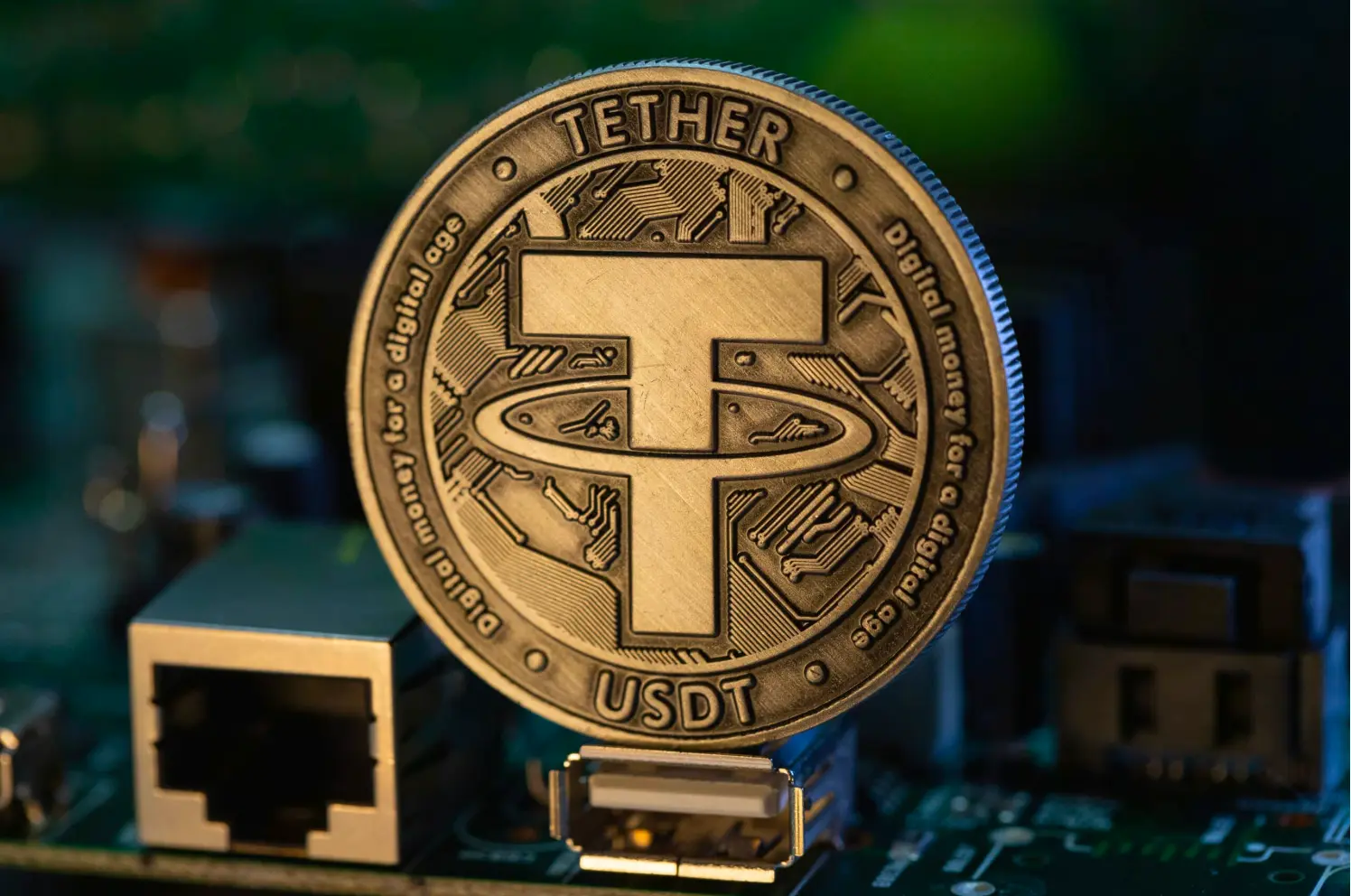
Tether is living a double life. USDT market cap is contracting for the first time in two years, with $6.5B burned in weeks, signaling reduced crypto liquidity. Yet Tether USA₮ CEO Bo Hines vows the firm will become a top 10 U.S. Treasury buyer in 2026, driven by its GENIUS-compliant stablecoin USAT. We examine the contradiction, the compliance pivot, and what Tether’s “split identity” means for Bitcoin, banks, and the $300B stablecoin market.
The Tether Contradiction: Shrinking Supply, Surging Treasury Ambition
On February 11, 2026, Bo Hines stood on stage at the Bitcoin Investor Week conference in New York and made a statement that, on its face, seemed to belong to a different company than the one making headlines elsewhere.
“This year, I think we’ll end up being a top 10 purchaser of T-bills,” said Hines, the former White House crypto advisor now serving as CEO of Tether USA₮.
The numbers support his confidence. Tether already holds more than $122 billion in U.S. Treasury Bills—83.11% of its total reserves. That places the stablecoin issuer between Germany and Saudi Arabia in the U.S. Treasury’s ranking of foreign holders of Treasurys, ahead of major sovereign nations.
Yet on the same day, across the same data feeds, a very different Tether story was unfolding.
CryptoQuant’s 60-day average USDT Market Cap Change indicator turned negative for the first time since the third quarter of 2023. USDT’s market capitalization has declined from over $187 billion in early January to approximately $184.3 billion. Tether has burned 3.5 billion USDT on February 10 and another 3 billion the previous month—the two largest consecutive burns in the company’s history.
How can the same firm simultaneously be contracting its flagship token supply and positioning itself as a top-tier buyer of U.S. sovereign debt?
The answer lies in Tether’s emerging dual identity: the global “shadow dollar” empire and the compliant American institutional player. They are no longer the same entity.
The USDT Shrink Signal: What the First Negative Growth in Two Years Really Means
Stablecoin supply trends are not abstract metrics. They are the plumbing of crypto liquidity.
When USDT expands, new dollars enter the ecosystem, typically finding their way into Bitcoin, Ethereum, and altcoin order books. When USDT contracts, capital is exiting—not waiting on the sidelines, but leaving the market entirely.
The February 2026 contraction is the first sustained decline since early 2025. Analyst Crypto Tice put it bluntly: “Historically, sustained upside in BTC doesn’t happen when stablecoin supply is contracting. Buying power weakens. Downside support becomes fragile. Rallies are sold off more quickly”.
Investor Ted was even more direct: “USDT supply is now in a downtrend for the first time since Q1 2025. Not a good sign”.
Yet history offers a nuanced counterpoint. Since 2022, periods when the 60-day average USDT market cap change turned negative have typically lasted about two months and often coincided with Bitcoin forming local bottoms—November 2022 to January 2023, August to October 2023. The current signal may indicate a bottoming process rather than the beginning of a prolonged bear market.
Still, the scale of the burns is unprecedented. Tether is not merely pausing issuance; it is actively destroying tokens at a rate of $6.5 billion in two months. This is not the behavior of a company experiencing weak demand. It is the behavior of a company managing its balance sheet through a transition.
The USAT Compliance Pivot: Tether’s ‘Made in America’ Stablecoin
The other half of the story is USAT.
Launched on January 27, 2026, USAT is Tether’s federally regulated, dollar-backed stablecoin, designed explicitly to comply with the GENIUS Act —the first comprehensive U.S. federal framework for payment stablecoins, signed into law in July 2025.
The contrast with USDT could not be starker.
USDT is global, offshore, and operates in the regulatory interstices of multiple jurisdictions. USAT is issued by Anchorage Digital Bank, the first federally chartered crypto bank in the United States, with Cantor Fitzgerald serving as reserve custodian and primary dealer. Its reserves are segregated, transparent, and subject to federal oversight. Bo Hines, who helped draft the GENIUS Act during his White House tenure, now leads the subsidiary.
Tether CEO Paolo Ardoino has called USAT “a dollar-backed token made in America,” designed for institutions that need federal oversight. The product is not a replacement for USDT; it is a parallel instrument for a parallel market.
This is the dual‑track strategy. USDT continues to dominate emerging markets, Latin America, Africa, and Southeast Asia—regions where dollar access is constrained and regulatory frameworks are more permissive. USAT targets U.S. institutions, publicly traded companies, and regulated financial intermediaries that cannot touch offshore stablecoins without legal risk.
Tether as a State‑Scale Financial Player: By the Numbers
To understand the scale of what Tether is building, one must move beyond the crypto lens and view the firm as a sovereign-adjacent financial institution.
Tether’s Financial Footprint
USDT Market Cap: ~$184 billion (post‑contraction)** **
USAT Market Cap: Launching January 2026; institutional ramp‑up underway** **
Treasury Holdings: $122+ billion (83.11% of reserves)** **
Global T‑Bill Ranking: Would rank 18th among foreign holders, between Germany and Saudi Arabia** **
Gold Holdings: ~140 tons, valued at ~$23‑24 billion — one of the largest private gold hoards worldwide** **
Excess Reserves: ~$30 billion above redemption requirements** **
2025 Profit: ~$15‑17 billion** **
Profit Reinvestment Rate: ~95% into Bitcoin, gold, AI, and infrastructure** **
Law Enforcement Partnerships: ~300 agencies across 60+ countries** **
Frozen Funds: ~$3.5 billion in suspicious assets** **
User Base: ~530 million, growing ~30 million per quarter
Tether is not merely a stablecoin issuer. It is a global macro investor operating with the balance sheet of a small nation, deploying capital into gold, Bitcoin, artificial intelligence, robotics, satellites, and even agricultural production. Its stake in Rumble—the right‑leaning YouTube competitor—and its deepening ties to Cantor Fitzgerald and the Trump administration signal a company that has moved far beyond its origins as crypto plumbing.
The ‘Shadow Empire’ and Its Legitimate Doppelgänger
The dual‑track strategy solves an existential problem that has dogged Tether since its founding.
USDT is the most widely used digital dollar on the planet, yet it lacks a legitimate identity in the United States. It cannot list on major U.S. exchanges in a fully compliant manner. It cannot be used by federally insured banks as a settlement asset. It exists in a state of perpetual regulatory ambiguity—useful, ubiquitous, but formally unrecognized.
USAT is the doppelgänger. It carries the same parentage, the same backing philosophy, but it is legally domiciled, federally examined, and institutionally palatable.
As one analysis put it, “Tether is starting to construct a ‘legal alter ego’ mechanism: no longer content with the role of a global financial conduit, but aiming to reshape its identity to become a compliant part of the U.S. financial order”.
This explains the apparent contradiction. USDT supply is contracting not because Tether is shrinking, but because capital is being repositioned. Some of the demand that previously flowed into USDT—particularly from professional traders and arbitrageurs—may now be migrating toward USAT as the compliance‑premium narrows.
The Banking Threat: Why Standard Chartered Warns of a $100 Billion Drain
Tether’s U.S. expansion is not occurring in a regulatory vacuum. It is colliding directly with the traditional banking system.
On the same day USAT launched, Standard Chartered published a report warning that stablecoins pose a “real threat” to U.S. bank deposits. Geoff Kendrick, the bank’s global head of digital assets research, estimates that for every dollar of stablecoin growth, approximately one‑third of that value permanently exits the banking system.
The mechanism is straightforward. When a customer moves money from a bank into a stablecoin, that deposit is removed from the bank’s balance sheet. When the stablecoin issuer purchases Treasury bills with those dollars, the funds do not return to the banking system. They remain in the non‑bank financial sector.
Tether holds just 0.02% of its reserves in bank deposits. Circle holds 14.5%. The rest is in Treasuries and other instruments outside the traditional deposit base.
Kendrick projects that if the stablecoin market reaches $2 trillion by 2028—a reasonable extrapolation from current growth—approximately $500 billion could leave developed‑market banks, with another $1 trillion exiting emerging‑market banks.
Regional banks face the highest exposure. Huntington Bancshares, M&T Bank, Truist Financial, and CFG Bank were specifically flagged as most vulnerable.
This is the structural tension beneath Tether’s compliance pivot. USAT may be regulated, federally compliant, and institutionally friendly—but it is still a non‑bank dollar substitute. Every dollar that migrates from a checking account to a USAT wallet is a dollar that will never fund a small business loan or a mortgage origination.
The GENIUS Act and the CLARITY Act: Regulation as Business Strategy
Tether’s timing is not accidental.
The GENIUS Act, passed in July 2025, created the regulatory runway for USAT by establishing clear federal standards for stablecoin issuers. Tether spent years operating outside that framework; now it is racing to become its most prominent beneficiary.
The pending CLARITY Act, expected to pass in Q1 2026, would prohibit stablecoin issuers from paying interest to token holders. For Tether, this is a competitive advantage. It has never paid yield to USDT holders, and it has no intention of doing so for USAT. For competitors like PayPal’s PYUSD or certain yield‑bearing stablecoin experiments, a blanket prohibition on interest payments would remove a key differentiator.
Bo Hines, who helped draft the GENIUS Act, is now positioned to shepherd Tether through the CLARITY transition. The revolving door between the White House Crypto Council and Tether’s C‑suite is not a coincidence; it is a deliberate strategy to embed the company within the U.S. regulatory apparatus.
The Emerging Market Engine: USDT’s 100x Ambition
While USAT pursues institutional legitimacy in the United States, USDT is being repositioned for a different kind of expansion.
Paolo Ardoino has articulated a vision of 100‑fold growth for USDT, targeting the 3‑4 billion people in emerging markets who lack access to stable banking infrastructure. The strategy is not to compete with JPMorgan in New York, but to replace collapsing local currencies in Argentina, Turkey, Nigeria, and Vietnam.
Ardoino has described USDT as a “financial social network,” where each new user increases the utility of every existing user. The company is investing in its own blockchain infrastructure—Plasma, Hadron, and the “QuantumVerse Automatic Computer” (QVAC)—to reduce transaction costs and enable micropayments at scale.
This is not speculative. Tether is already profitable enough to reinvest 95% of its earnings into this infrastructure, forgoing dividends and shareholder distributions in favor of long‑term network dominance.
The Unanswered Question: Can One Company Be Both?
Tether’s dual‑track strategy is elegant in theory. In practice, it requires managing irreconcilable tensions.
USAT demands transparency, federal oversight, and institutional relationships. USDT thrives in the shadows—fast, cheap, and indifferent to sanctions compliance. The same executive team must answer to Cantor Fitzgerald and to the anonymous whale wallets that move billions through mixers.
Critics remain unconvinced. Austin Campbell, managing partner of Zero Knowledge Consulting, summarized the skepticism: “How much of this is marketing and how much is held belief? How do you square ‘the world is ending’ with ‘we’re reinventing tech and everything is going to be great’? Internal consistency has never been a strength of the crypto space”.
Tether’s conference in El Salvador offered a vivid portrait of this internal dissonance. Employees wore name tags with only first names for “privacy.” Giancarlo Devasini, the intensely private Italian former plastic surgeon who owns a large stake and remains the firm’s strategic core, floated through the event in all‑white clothing but declined all interviews. Ardoino was summoned mid‑session by President Bukele.
Yet the same company is hiring AI filmmakers in Italy, venture investment associates in the UAE, and regulatory affairs leads in Ghana and Brazil. It is building a gleaming office tower in San Salvador and stockpiling land and gold for a “fortress” against societal collapse.
What Comes Next: Three Implications
For Bitcoin: The USDT contraction is a near‑term headwind. Liquidity is leaving the market, and $60,000 support remains fragile. But if historical patterns hold, the bottoming process may conclude within two months. Tether’s continued accumulation of Bitcoin—now a standard component of its reserve diversification—provides a structural bid that did not exist in previous cycles.
For U.S. Banks: The threat is real and escalating. Federally regulated stablecoins do not eliminate the deposit drain; they accelerate it by granting institutional legitimacy to non‑bank dollar substitutes. Regional banks facing the highest exposure will need to adapt or consolidate.
For Tether Itself: The dual‑track experiment will be tested in 2026. USAT must gain traction against USDC, which has a multi‑year head start in the U.S. institutional market. USDT must maintain its dominance in emerging markets despite increasing regulatory pressure from the EU’s MiCA framework and similar regimes. And the two products must remain sufficiently distinct that problems in one do not contaminate the other.
Conclusion: The Decentralized Central Bank
A person familiar with Tether’s business posed a question that captures the company’s current trajectory: “The question is what do you do with all that money? Their ambitions are large. They see themselves as a decentralized central bank”.
Central banks manage dual mandates: price stability and economic growth. They do not, however, manage dual identities.
Tether is attempting something unprecedented in financial history. It is building a compliant, regulated, institutional‑grade dollar token for the world’s most scrutinized financial market while simultaneously expanding a global, offshore, minimally supervised digital currency that operates beyond the reach of any single regulator.
The $122 billion in Treasuries, the 140 tons of gold, the 530 million users, the 300 law enforcement partnerships, the $30 billion excess reserve cushion—these are not the characteristics of a company in crisis.
They are the characteristics of a company that has outgrown its original design and is now building, in real time, the infrastructure for whatever comes after the traditional banking system.
USDT is shrinking. USAT is rising. The old empire is not dying. It is splitting in two.
What emerges on the other side may not resemble anything the crypto industry has seen before.
Related Articles
Utexo: Launches an adaptation layer to support the RGB protocol for Tether wallet development suite
Tether tests the local AI assistant QVAC, with plans to open source it
Bloomberg Analyst: If ETH drops to $1500, Tether's market capitalization will surpass ETH
Tether challenges the top 10 buyers of U.S. debt! Holdings of 122 billion have surpassed Germany
Tether Invests in LayerZero to Expand USDt0 Interoperability