


Analyst Bernstein predicts Bitcoin price at $150,000, while new Dogecoin Maxi Doge takes the pre-sale spotlight
New Project Maxi Doge ($MAXI) leverages its unique fitness and leverage culture narrative. According to the official statement, during the pre-sale phase, it successfully raised over $4.58 million, becoming a focal point amid market weakness.
(Background recap: Bitcoin drops below $66,000, Ethereum hits $1,900, non-farm payroll data causes 150,000 liquidations and $470 million in losses)
(Additional context: K33: Bitcoin at $60,000 may have already bottomed out! Multiple historic panic sell signals have appeared)
Table of Contents
- The logic behind the weakest bear market in history
- Underlying support from ETFs and institutionalization
- Deconstructing concerns over quantum computing and AI
- An alternative path in the meme market: Maxi Doge
- Conclusion
- Disclaimer
(This article is a promotional piece provided by Maxi Doge; it does not represent the stance of Dongqu. This involves memecoin-related tokens, which may carry extremely high volatility risks and is not investment advice. See the disclaimer at the end.)
In February, the crypto market sought a new balance amid volatility, with Bitcoin retracing and altcoins exhibiting high fluctuations. Funds flowed back into more consensus-driven assets on one side, while on the other, attention shifted to presale projects with buzz and incentive designs. Bernstein analyst Gautam Chhugani, in a recent report, maintained a long-term bullish stance on Bitcoin, even describing this correction as the weakest bear market in history, reasoning that the market is mainly affected by confidence correction rather than structural damage to fundamentals.
Meanwhile, a new cultural route has emerged in the meme market. The official statement says that Maxi Doge ($MAXI) enters with a dramatic narrative centered on fitness, extreme energy, and leverage spirit, creating strong visual memory and community recognition. Presale price is $0.0002803, with over $4.58 million raised, approaching $4.6 million.
The logic behind the weakest bear market in history
Bernstein’s core view is that there have been no systemic events typical of past bear markets, such as major platform collapses, hidden leverage chain failures, or complete market liquidity freeze.
The report compares historical crises like Mt. Gox, Terra Luna, FTX, and Three Arrows Capital, concluding that this downturn lacks equivalent structural shocks. Therefore, it resembles a price correction driven by investor sentiment cooling rather than fundamental breakdowns. Led by analyst Gautam Chhugani, the team reaffirms that the Bitcoin network remains stable, with no signs of uncontrolled liquidations, and maintains a target of $150,000 by the end of 2026.
ETF and institutional support underpinning
The report attributes the current cycle’s differences from previous ones to a higher degree of integration between Bitcoin and the mainstream financial system. The approval and operation of US spot Bitcoin ETFs provide sustainable capital inflow/outflow channels and more mature market infrastructure. Bernstein notes that despite recent volatility, net outflows from spot ETFs are about 7%, indicating institutional long-term holdings remain resilient. As global liquidity conditions loosen, existing ETF structures are more likely to quickly absorb new capital, enhancing Bitcoin’s transmission efficiency during recovery phases. The report also mentions that under high interest rates and tightening financial conditions, Bitcoin is still viewed as a liquidity-sensitive risk asset, not yet exhibiting safe-haven properties like gold; this reflects a phase preference in the overall environment rather than a loss of value.
Beyond ETFs, Bernstein sees the pro-cryptocurrency political climate in the US, corporate adoption of Bitcoin on balance sheets, and increased participation from large asset managers as long-term bullish drivers. The report states that market sentiment seems to amplify crises on its own, with occasional pessimistic narratives about Bitcoin. However, infrastructure and capital channels remain intact. When macro pressures ease, Bitcoin’s recovery ability may surpass previous levels.
Deconstructing concerns over quantum computing and AI
Regarding fears that quantum computing could crack Bitcoin’s cryptography, Bernstein believes this is a long-term challenge faced by all digital systems, not a specific weakness of Bitcoin. Bitcoin’s open-source code and resourceful ecosystem participants mean future upgrades can align with traditional finance’s quantum-resistant standards. Another common concern is whether AI-driven economies will marginalize Bitcoin. Bernstein counters this by suggesting that blockchain and programmable wallets, driven by autonomous software agents, can provide machine-readable, cross-border, 24/7 operational financial rails—capabilities that traditional banking systems, constrained by old architectures and API gaps, find hard to deliver.
Market fears also include large corporate leverage and miner forced sales as risk factors. Bernstein argues that companies like Strategy have mitigated short-term pressures through long-term preferred stock or structured debt arrangements. CEO Phong Le estimates that only if Bitcoin falls to $8,000 and remains there for five years would their balance sheets need restructuring—an unlikely scenario under current market conditions. This suggests that passive supply-side selling may not be as fragile as the market fears.
An alternative path in the meme market: Maxi Doge
While institutional narratives support Bitcoin’s bottom, the meme coin market continues to be driven by cultural dissemination and community momentum. Maxi Doge exemplifies this. It uses themes of fitness, extreme energy, and leverage as branding language, creating strong visual and social recognition, emphasizing an active community that can quickly attract attention during shifts in public opinion and social buzz.
Data-wise, MAXI’s presale price is $0.0002803, with over $4.58 million raised, approaching $4.6 million.
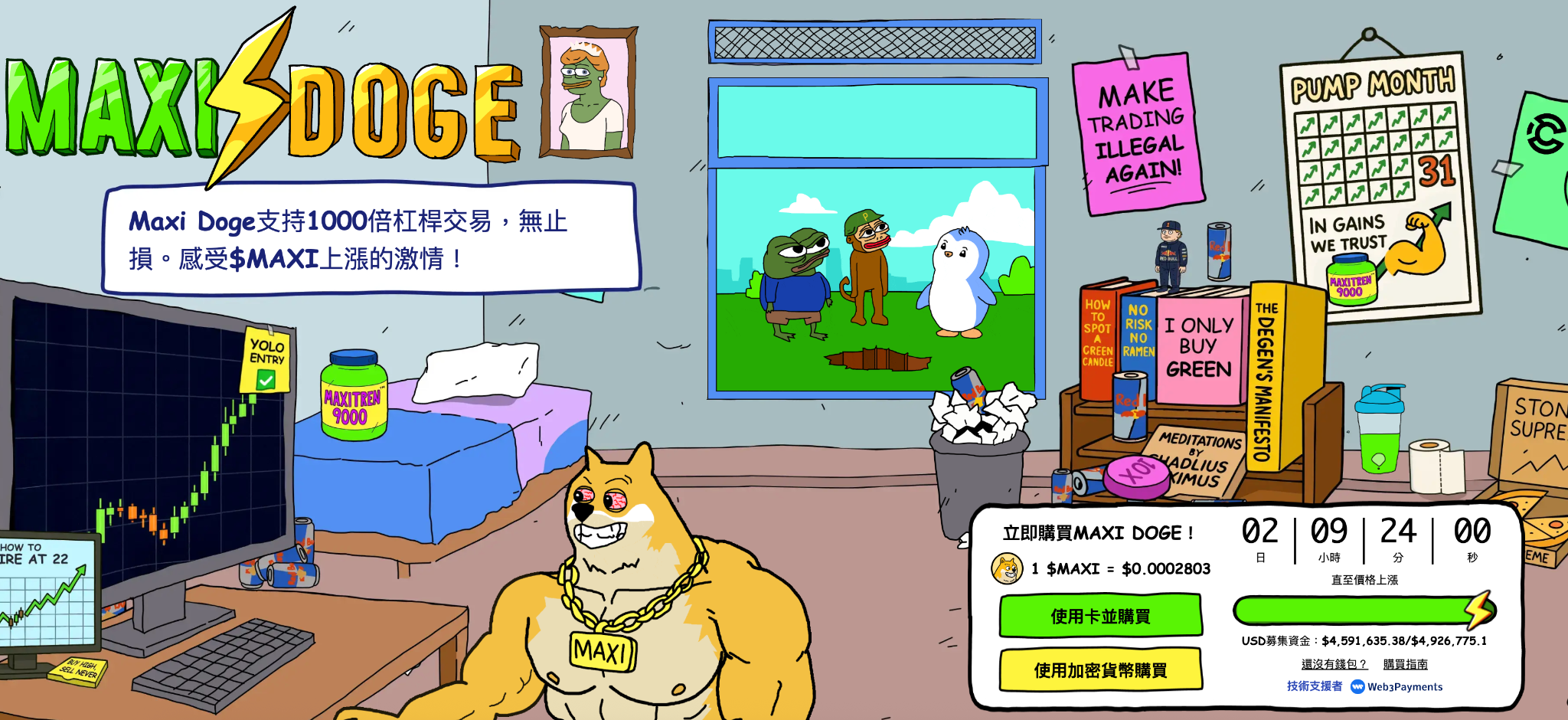
Maxi Doge’s appeal comes not only from its cultural symbolism but also from incentive mechanisms during the presale. The project offers a 69% annual staking yield and allocates 5% of total supply to a staking reward pool, aiming to align rewards with resource backing rather than unlimited issuance.
The team also reserved 25% of tokens to establish the MAXI fund, used for community competitions, KOL collaborations, branding projects, and potential future integrations with leverage trading platforms. This approach shifts the meme coin narrative from a single-topic focus to an incentivized, activity-driven entertainment crypto product.
Official website to purchase Maxi Doge
Conclusion
From Bernstein’s perspective, Bitcoin’s core support stems from ETF infrastructure, institutional resilience, and more mature capital channels. Therefore, this correction appears more like a confidence adjustment, with the $150,000 target by 2026 reflecting belief in the cycle’s continuation. Conversely, Maxi Doge represents a high-volatility alternative, leveraging a distinctive cultural identity, 69% annual staking, a 5% reward pool, and 25% fund allocation. Despite market weakness, it has already raised over $4.58 million in presale.
These two paths correspond to different risk tolerances and time horizons, developing in parallel within the same market. They also reveal that by 2026, capital flows are simultaneously betting on both institutionalization and community-driven forces.
Disclaimer
Cryptocurrency investments carry high risks, with significant price volatility that may lead to capital loss. This article is for informational purposes only and does not constitute investment advice. Please conduct your own research (DYOR) and exercise caution.
Promotional disclaimer: This content is a promotional article provided by the contributor, with no affiliation to Dongqu. It does not represent Dongqu’s position. It is not intended to offer investment, asset, or legal advice, nor should it be considered an offer to buy, sell, or hold assets. Any services, solutions, or tools mentioned are for reference only, with final details subject to the issuer’s announcements. Dongqu is not responsible for any risks or losses; readers should verify information carefully before making decisions or taking actions.
Related Articles
Dogecoin Holds $0.095 Support as 4-Hour Bull Flag Targets $0.120
Memecoin: Dogecoin, Shiba Inu, and Pepe continue to plummet under increasing selling pressure
Retail investors flee, whales scoop up the bottom! PEPE smart money returns, absorbing 23 trillion tokens in four months