


American host's mother kidnapped! The kidnappers demand 85 Bitcoin ransom, but police searches have been unsuccessful.

Today Show host’s mother kidnapped in the U.S., kidnappers demand $6 million in Bitcoin, case stalls, sparking widespread societal anxiety over crypto crime and regulation, with political tensions rising sharply.
U.S. Renowned Host’s Mother Kidnapped, Demands $6 Million in Bitcoin
The family of Savannah Guthrie, host of the popular U.S. news program Today, recently faced a major crisis. According to reports, her 84-year-old mother, Nancy Guthrie, was kidnapped on February 1, 2026, from their home in the suburbs of Tucson, Arizona.

Image source: People U.S. renowned news program Today host Savannah Guthrie
Although law enforcement has not officially confirmed the authenticity of the ransom demand, multiple media outlets including TMZ, CBS, and TUCSON have received two ransom notices, and the media generally consider these demands highly credible. The kidnappers offered a ransom of 6 million dollars worth of Bitcoin (BTC) and set a specific deadline, with one notice even containing a threat of “consequences if not paid.”
Notably, due to fluctuations in the cryptocurrency market, the exact amount of Bitcoin demanded has changed significantly. As Bitcoin’s price has recently fallen, the total Bitcoin equivalent of the demanded amount may now exceed the initial $6 million. Calculations show that on February 9, $6 million was approximately 85 BTC, but on the day of the kidnapping, February 1, it was roughly 75 to 76 BTC.
Because of this sudden family crisis, Savannah Guthrie, who was scheduled to cover three Olympic Games, has had to miss this year’s broadcast. Her colleagues publicly expressed their support and well wishes during the opening ceremony. Currently, media outlets remain uncertain whether the kidnappers are demanding a fixed dollar value in Bitcoin or a specific amount of crypto assets.
Police investigation yields no results; family releases video pleading for safe return
The investigation into this case has been fraught with difficulties. Early on, a man from California sent a false ransom demand to the Guthrie family, attempting to profit amid the chaos. Later, it appears the real kidnappers broke their initial statement of “not contacting media” and sent a second ransom letter.
According to a CNN report relayed by a KOLD reporter, this second letter was shorter than the first and seemed to serve as a “proof” that Nancy was still in their control. Although the email communication used by the kidnappers is believed to be heavily encrypted and difficult to trace, concerns remain because no concrete “proof of life” has been shared with the family, making the situation more dire.
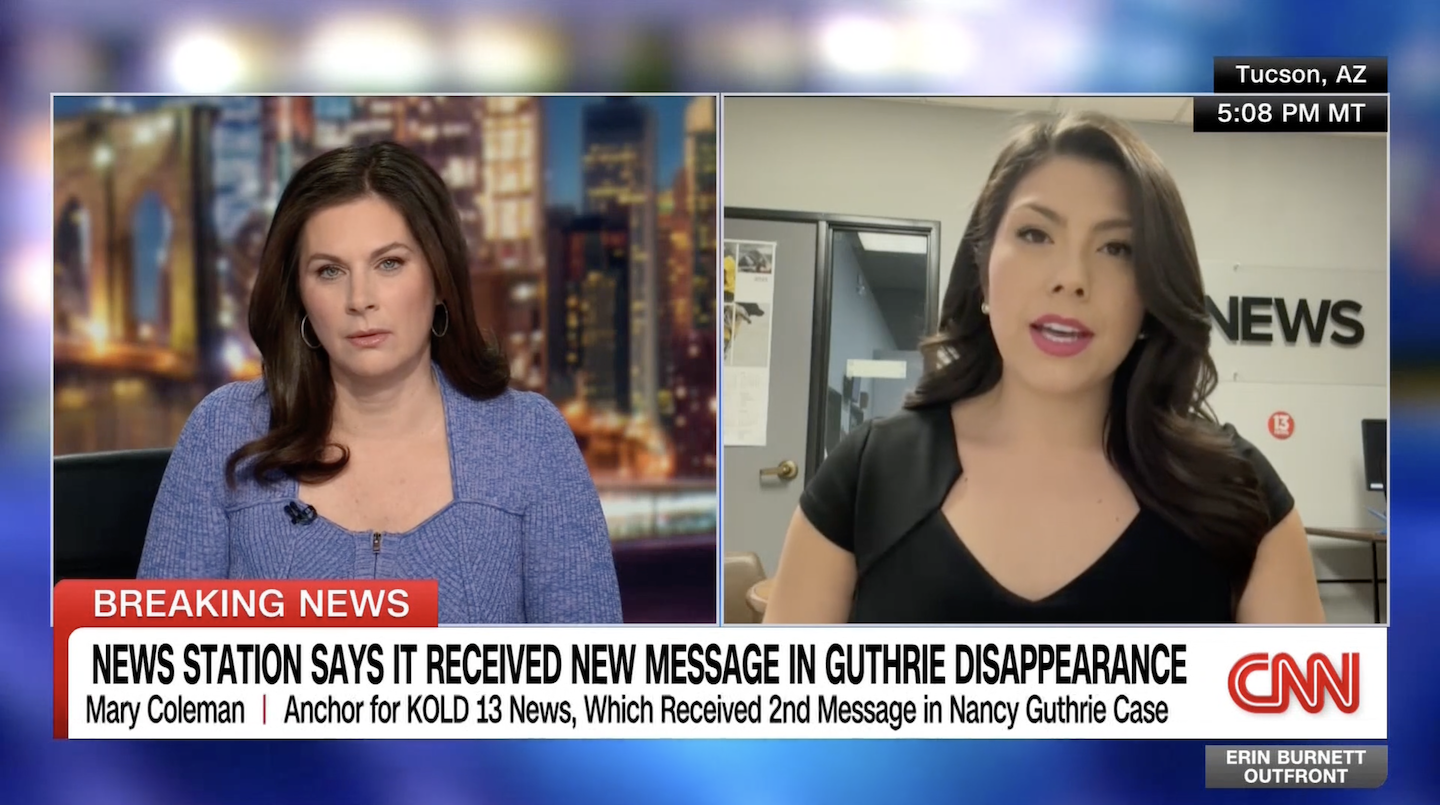
Image source: CNN, KOLD reporter relays the letter provided by kidnappers
The Guthrie family subsequently released a heartbreaking public video, directly addressing the kidnappers. In the video, family members state they have received the information and fully understand the kidnappers’ demands, pleading for the safe return of their mother and emphasizing they are willing to pay a very high price for her safety.
However, law enforcement progress appears to be stalled. Despite at least three thorough searches of the Tucson crime scene, no surveillance footage, vehicle descriptions, or valuable clues have been obtained. Details about the ransom payment are also uncertain; it is unclear whether the kidnappers require Bitcoin to be sent to a single wallet, multiple addresses, or if they believe they can evade detection through exchanges and mixers.
Crypto crime sparks societal anxiety; mainstream groups confront blockchain’s dark side
This kidnapping not only deals a heavy blow to the Guthrie family but also unexpectedly raises awareness among the broader American mainstream audience about the risks of cryptocurrencies. With Today averaging about 3 million viewers daily, and a predominantly older demographic, this ongoing coverage is exposing this segment of the population to the darker aspects of blockchain technology—an area they are generally less familiar with.
The use of crypto assets for ransom payments has heightened public concern about the potential for cryptocurrencies to enable criminal activity, possibly escalating into political issues. In fact, senior executives in the crypto industry have already begun significantly increasing their private security teams in response to high-profile kidnapping cases.
Some analysts also point out that this type of crime resembles the “Pig Butchering” scams prevalent in Southeast Asia. While traditional Pig Butchering scams typically involve imprisoning victims in regions like Cambodia, Laos, or Myanmar to carry out telecom fraud, one of their secondary income sources is demanding ransom from victims’ families.
Although the $6 million ransom in the Guthrie case far exceeds typical Pig Butchering scam amounts, both crimes exploit the anonymity and cross-border transfer capabilities of cryptocurrencies. Interestingly, the kidnappers chose Bitcoin rather than Monero ($XMR) or Zcash, which are harder to trace. Whether this decision was due to Bitcoin’s liquidity or other reasons remains unclear. Investigators continue to analyze the motives behind this choice. This case serves as a stark warning that crypto-related crimes are crossing borders and social boundaries, becoming a societal issue everyone must face.
Related Articles
U.S. listed company Addentax plans to raise $200 million through a rights issue to support its cryptocurrency and AI strategies
Today's Cryptocurrency News (February 11) | Hong Kong Stablecoin License Soon to be Issued; Trend Research Loses $869 Million
Dragonfly Partner: The current market sentiment is far from the despair during the FTX collapse, and the fundamentals of the crypto industry remain solid.
Bitcoin Downturn Is a ‘Crisis of Confidence,’ Not a Broken Market: Bernstein