


A child spent $100 in 1993 to buy the AI.com domain name, then sold it for $70 million? Foreign media point out multiple suspicious points

It is circulating online that a Malaysian man bought the domain AI.com for $100 when he was 10 years old and sold it for $70 million. Foreign media question the credibility of this story, noting that online credit card use and widespread internet access were not available at that time, and that the seller’s identity being revealed could lead to significant tax scrutiny.
Online rumors claim that a 10-year-old child in 1993 purchased the AI.com domain, but foreign media have verified doubts about this story.
One of the hottest topics in the tech world recently is the sale of the domain AI.com for a staggering $70 million in 2025. Recently, a message has been circulating on social media claiming that a Malaysian media outlet SAYS reported that the seller, Arsyan Ismail, said he bought the domain in 1993 at age 10 by stealing his mother’s credit card for $100.
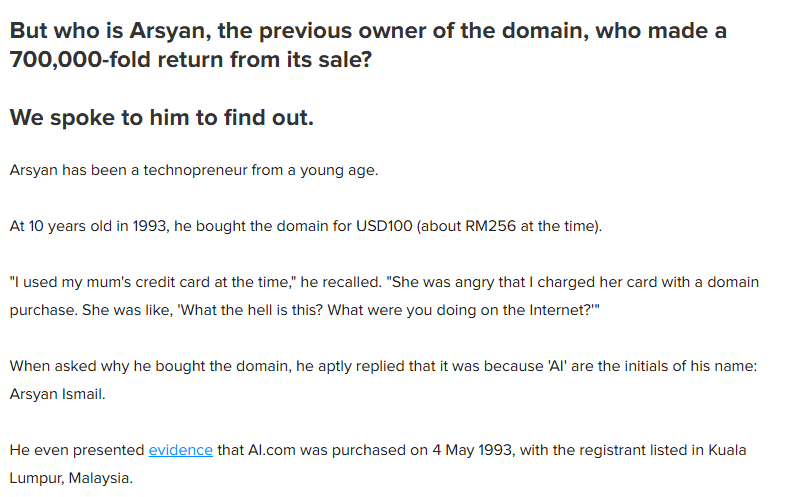
Image source: SAYS, Malaysian media. The report states that Arsyan Ismail, the seller of AI.com, claims he bought the domain in 1993 at age 10 by stealing his mother’s credit card for $100.
If this story is true, it means that this investment has yielded an astonishing 70 million times return over 32 years. As a result, some social media accounts have started spreading this story, and Taiwanese crypto media have also reported on it.

Image source: Facebook screenshot, Taiwanese crypto media reporting that a 10-year-old bought AI.com for $100, which later sold for $70 million.
Lowyat raises doubts: Could a 10-year-old have used a credit card to buy a domain in 1993?
However, another Malaysian tech media outlet, Lowyat.net, questioned this story today (2/11), pointing out that, given the technological context of the time, it was highly unlikely for a 10-year-old to have used a credit card to purchase a domain.
According to Lowyat.net’s investigation, AI.com was indeed registered on May 4, 1993, just five days after the World Wide Web became publicly accessible, which is indisputable.
However, online credit card transactions did not occur until August 1994 or fall 1993, and online credit card mechanisms were only officially approved in 1996. The CVV security code on credit cards was only introduced in 1997.
Additionally, Malaysia’s first internet service provider, Jaring, was established in 1992, but commercial dial-up internet only became widespread in 1995. Before 1995, domain registration was free, but owners needed the capability to set up dedicated DNS servers and maintain permanent internet connectivity.
In that era, maintaining a domain required substantial infrastructure and technical expertise, which would have been difficult for large corporations, let alone a 10-year-old child, regardless of technical skill or financial resources.
The purchase date of AI.com by the Malaysian seller may have been in 2021
If not in 1993, then what could be the actual story? Lowyat.net cites tracking data from investors George Kirikos and investigator Bill Patterson, indicating that Arsyan Ismail most likely purchased the domain in 2021 through the domain broker site SAW.com, with the exact price not publicly disclosed.
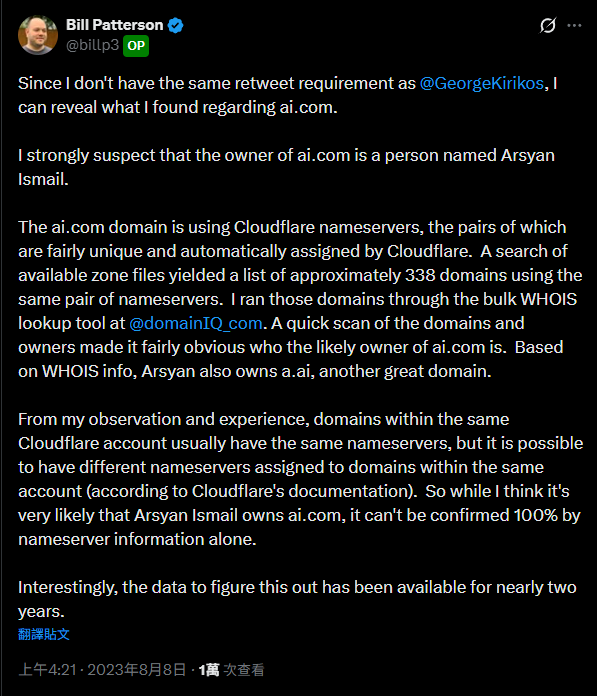
Investigations show that before Arsyan Ismail acquired it, AI.com was owned by Future Media Architects, Inc., a company affiliated with Kuwait’s well-known top-level domain collector Thunayan Khalid AL-Ghanim. This suggests that Arsyan Ismail probably bought it around 2021 and recently sold it for $70 million. His profit might still be substantial, but it’s unlikely to be the story of holding the domain for 32 years before selling.
Currently, on social media, there are posts questioning the authenticity of the story claiming that a 10-year-old bought AI.com.

Image source: X (Twitter)
After the seller’s identity was revealed, there is concern that tax authorities may scrutinize the transaction
This transaction came to light after domain broker Larry Fisher posted on LinkedIn, directly revealing the seller’s identity. Usually, large domain deals are kept confidential, especially when not involving publicly listed companies.
Lowyat.net analyzed that revealing the seller’s identity might not be beneficial, as Malaysia’s Inland Revenue Board (LHDN) would take notice. Given the $70 million sale price paid in cryptocurrency, the seller could face significant capital gains tax, but the local tax authorities currently do not accept cryptocurrency payments.
It’s unclear whether Larry Fisher’s disclosure of the seller’s name was authorized or an accidental “name drop,” but as the news spreads on social media and news outlets, the seller may face strict tax scrutiny.
Further reading:
Popular post triggers Taiwanese media misreport: Horonod climbing 101 photographer is Jin Guowei, media literacy challenges in the AI era